
Breaking News
What Claude Opus 4.8 Actually Changes for Your 5-50 Person Business
Anthropic shipped Claude Opus 4.8 this week, and the coverage has mostly been written for developers and AI researchers. That's frustrating if you're a business owner who already pays for Claude and just wants to know: does this matter to …
June 2, 2026 · 6 min read
What Claude Opus 4.8 Actually Changes for Your 5-50 Person Business
Anthropic shipped Claude Opus 4.8 this week, and the coverage has mostly been written for developers and AI researchers. That's frustrating if you're a business owner who already pays for Claude and just wants to know: does this matter to me?
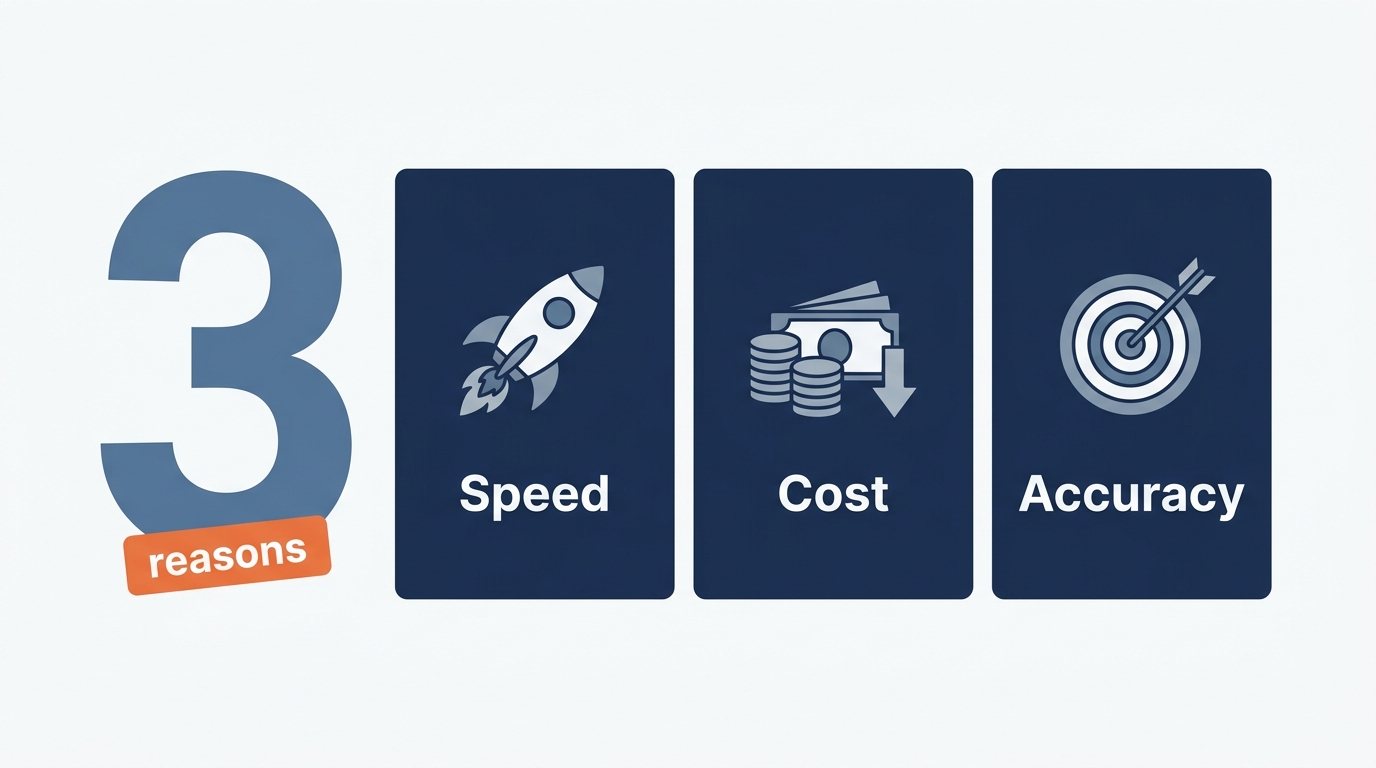
Short answer: yes, for three specific reasons. Let me walk through each one.
First, a Quick Reality Check on "New Model" Announcements
Most model updates are benchmark theater. Company X releases a chart showing their new model scores 2.3% better on some test you've never heard of. You nod, close the tab, and go back to work.
Opus 4.8 is different because the three changes Anthropic is highlighting aren't about abstract capability. They're about reliability and cost, which are the two things that actually determine whether an AI tool makes it into your daily workflow or sits unused.
Here's what changed.
Change 1: The Model Now Flags Its Own Mistakes
This is the one I'm most excited about for SMB owners, and it's also the hardest to explain without sounding like marketing fluff. So let me be specific.
The old problem: Claude (and every other AI model) has a confidence problem. When it doesn't know something, it often just... keeps going. It presents a shaky answer with the same tone as a solid one. Anthropic described this directly, saying "a general problem with AI models is that they sometimes jump to conclusions, confidently presenting their work as making progress despite thin evidence."
If you've used Claude to write a proposal, draft a contract clause, or pull together a competitive analysis, you've probably experienced this. The output looks great. The logic sounds airtight. Then you catch a number that's wrong, or a claim that doesn't hold up, and you realize you almost sent that to a client.
Opus 4.8 is trained to flag those moments instead of bulldoze through them. Early testers reported that the model is more likely to say "I'm not certain about this" or "you should verify this figure" rather than presenting everything with equal confidence.
What this means in practice: If you're using Claude for customer-facing documents, financial estimates, or anything where a wrong answer has real consequences, you'll spend less time fact-checking everything and more time just checking the things Claude tells you to check. That's a genuine workflow improvement, not a talking point.
A concrete example: imagine you're a 12-person marketing agency using Claude to draft case study content. You ask it to pull together performance benchmarks for a client's industry. Old Claude gives you numbers and moves on. New Claude gives you numbers and flags two of them as uncertain, telling you to verify before publishing. That saves you an embarrassing correction email to a client.
Change 2: Dynamic Workflows Can Coordinate Up to 1,000 Subagents
This one sounds like science fiction, so let me ground it quickly.
A "subagent" in this context is just a separate AI instance handling one piece of a larger task. Think of it like hiring a temp agency: instead of one person doing everything sequentially, you have a team working in parallel on different parts of the same project.
Anthropic's new Dynamic Workflows tool (currently in research preview inside Claude Code) lets Opus 4.8 spin up and coordinate up to 1,000 of these subagents on a single task. The model acts as the orchestrator, breaking a big job into smaller pieces, assigning them out, and synthesizing the results.
For context on what this actually enables: say you run a 30-person e-commerce operation and you want to audit every product description on your site for tone consistency, SEO gaps, and compliance language. That's potentially thousands of pages of work. With the old approach, you'd either do it manually, hire someone, or run Claude in a slow loop that takes hours. With Dynamic Workflows, that job gets parallelized. Multiple subagents tackle different product categories simultaneously, and the orchestrating model pulls it together.
Or think about a law firm using Claude to review a stack of contracts for a due diligence process. Instead of feeding documents one at a time, Dynamic Workflows can distribute the review across many subagents and return a consolidated analysis.
The honest caveat: This is still in research preview, which means it's not fully baked. I wouldn't build a production workflow around it today without testing it carefully first. But if you're the kind of owner who likes to stay a few months ahead of what's possible, this is worth watching closely.
Change 3: Fast Mode Makes Production Use Cheaper
This is the most straightforward change and probably the one with the most immediate dollar impact.
Anthropic also shipped a cheaper "Fast Mode" with Opus 4.8. The idea is that not every task needs the full horsepower of the model. If you're running Claude in an automated workflow, like auto-drafting follow-up emails, triaging support tickets, or generating first-pass social copy, you don't need the model thinking as hard as it would for a complex coding task.
Fast Mode lets you run those lighter tasks at a lower cost. Anthropic hasn't published a precise cost-per-token breakdown that I'd stake my reputation on right now, so I won't throw out a specific number. But the principle matters: if you're building or considering building any automated workflow with Claude at the core, your cost structure just got more flexible.
For a 20-person company running Claude on a few hundred automated tasks per day, this could be the difference between an AI tool that's clearly worth the spend and one you're always second-guessing on the monthly invoice.
So What Should You Actually Do This Week?
You don't need to overhaul anything. Here's a simple three-step response to this update:
1. If you use Claude for proposals, reports, or client documents: Pay attention to uncertainty flags in your next few outputs. Don't dismiss them as the model being wishy-washy. Treat them as a checklist. The model is telling you where to spend your verification energy.
2. If you're building or considering an automated Claude workflow: Look at whether Fast Mode applies to any of the lighter tasks in that workflow. The goal is to use the full model where it matters and the cheaper mode where it doesn't.
3. If you have a large, repetitive analysis task sitting on your backlog: Keep an eye on Dynamic Workflows. It's not production-ready for everyone today, but if your task involves processing a lot of similar items in parallel (product reviews, document audits, data enrichment), this is exactly what that tool is being built for.
The Bottom Line
Opus 4.8 isn't a complete reinvention of Claude. It's a meaningful step toward AI that's more trustworthy on output quality and more economical to run at scale. For a 5-50 person business, those are the two things that actually move the needle on whether AI becomes a real part of your operations or stays a novelty.
More honest outputs mean less babysitting. Cheaper fast tasks mean better unit economics on automation. Better parallel processing means bigger jobs become tractable.
That's worth knowing about.
If you want a straight-talk breakdown of AI updates like this one every week, written for business owners (not developers), subscribe to the Cognuvi newsletter. No hype, no benchmarks nobody asked for. Just what changed and whether it matters to you.
And if you're trying to figure out whether any of this applies to something specific you're building or automating, book a free 30-minute discovery call. We can look at your situation and tell you honestly whether there's something here worth acting on.